
Arabic vs English Google Ads in the GCC: How to Split Campaigns, Ad Copy and Landing Pages
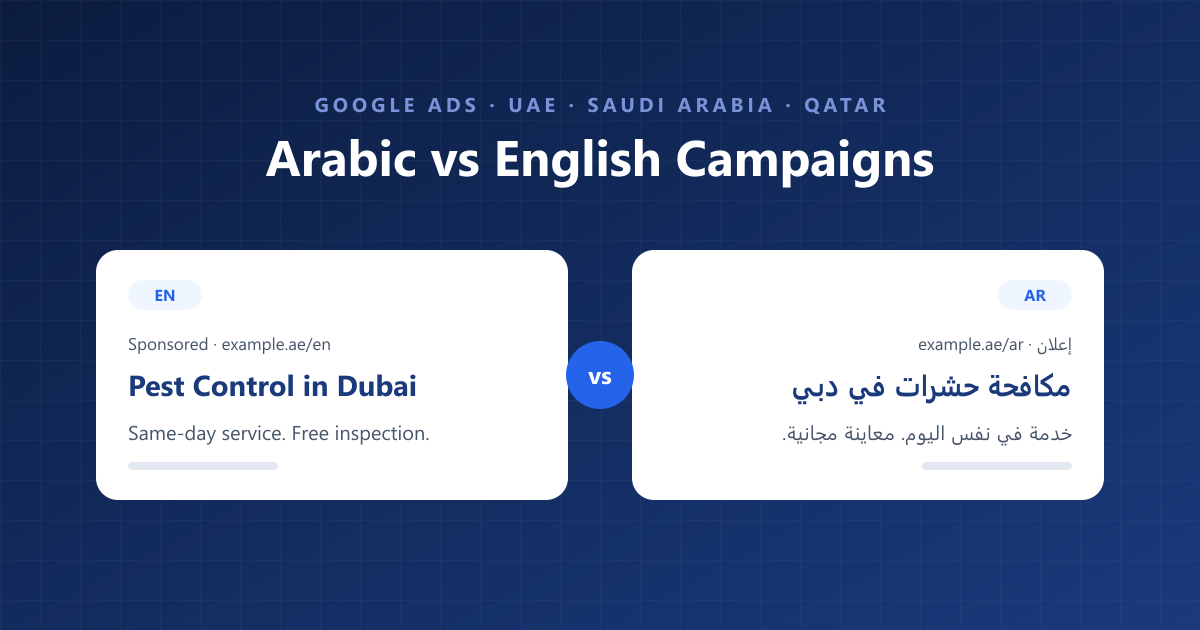
In the GCC, one city can hold two very different searchers. A villa owner in Jumeirah searches "pest control Dubai". A Saudi family in Riyadh searches "مكافحة حشرات بالرياض". Both want the same service. If one ad group, one English ad and one English landing page try to serve both, you pay for clicks from the Arabic searcher who bounces.
Many GCC accounts we audit mix the two languages, or run Arabic as a quick translation of the English campaign. This guide shows how we structure Arabic and English Google Ads for clients in the UAE, Saudi Arabia and Qatar, and what changed after Google removed the campaign language setting in September 2026.
Quick answer: Run Arabic and English as separate campaigns (or at minimum separate ad groups), each with its own keywords, natively written ad copy and a landing page in the same language. Since September 2026, Google matches Search ads to users mainly by the language of the search term and of your ad and landing page, not by a campaign setting. So the language of your ads and pages is now your language targeting. Split budgets by market: Arabic usually deserves a larger share in Saudi Arabia than in the UAE or Qatar. Track conversions and lead quality by language so you can compare both on cost per qualified lead.
How does Google Ads language targeting work in 2026?
From September 2026, Search campaigns no longer have a campaign language setting. Google decides which ad to show from the language of the search term, the language of your ad and landing page, and the user's languages. Google announced the change in August 2026, after first planning it for the end of 2025.
What this means for bilingual GCC accounts:
- Query language now leads. When a search has a clear language, Google prioritises the ad and landing page in that language (Google Ads Help). An Arabic query is steered towards your Arabic ad, if you have one.
- Google does not translate your ads. If you have no Arabic ad, an Arabic searcher who also reads English can still see your English ad. That is often a weaker match and a lower conversion rate.
- Performance Max is affected too. Its Search placements follow the new Search behaviour. Language settings still apply to YouTube, Display, Discover and Gmail inside PMax. See our Performance Max guide for the controls that remain.
- Separate language campaigns still work. Google confirmed that single-language structures, such as one English and one Arabic campaign, keep working as before.
- The language of your assets is now your targeting. An English headline inside an "Arabic" ad group sends a mixed signal. Keep every asset in a campaign in one language.
The same month, automatically created assets and campaign-level broad match moved to AI Max. If performance shifted in your GCC account in September 2026, check both changes before you blame either.
Should Arabic and English run as separate campaigns or separate ad groups?
Use separate campaigns per language when each language has enough budget to learn. Use separate ad groups inside one campaign only when the budget is too small to split. Never mix Arabic and English keywords or ads in one ad group.
| Option | When to use it | Pros | Cons |
|---|---|---|---|
| Separate campaigns per language (recommended) | Each language can fund its own daily budget | Own budget, bids, schedule and reporting per language | Each campaign needs enough conversions for Smart Bidding |
| Separate ad groups in one campaign | Small budget, one market | Pooled conversion data for bidding | One shared budget, so English can take most of the spend |
| Mixed ad groups | Never | None | Wrong ad shown, unclear reporting, wasted clicks |
A structure we use for a service business across the GCC:
- Campaign: UAE | Search | EN | Pest Control
- Ad group: General pest control (EN)
- Ad group: Cockroach treatment (EN)
- Ad group: Bed bug treatment (EN)
- Campaign: UAE | Search | AR | Pest Control
- Ad group: مكافحة حشرات (general)
- Ad group: مكافحة صراصير (cockroaches)
- Ad group: مكافحة بق الفراش (bed bugs)
- Campaign: KSA | Search | AR | Pest Control (and an EN campaign if expat demand is proven)
Name campaigns with country, network, language and service in the same order. It makes filtering and reporting by language a two-second job.
One market per campaign matters as much as one language. Saudi Arabia, the UAE and Qatar differ in cost per click, currency, working days and search behaviour. In the UAE, a separate landing page per emirate can also lift relevance; budget and location targeting then follow the same split.
How should you build Arabic and English keyword lists?
Build the Arabic keyword list from how people in that market actually search, not by translating the English list. Pull real queries from the search terms report after two to three weeks and add what you find.
What to cover in Arabic keyword research:
- Spelling variants. The same word can be typed with or without hamza and with ة or ه at the end. Google often matches close variants, but check search terms to confirm.
- With and without "ال". "مكافحة الحشرات" and "مكافحة حشرات" both appear in real queries.
- Gulf dialect words. Searchers often use local words alongside Modern Standard Arabic. A native Gulf speaker on the team catches these quickly.
- City names in Arabic. دبي, الشارقة, أبوظبي, الرياض, جدة, الدوحة — plus "بالرياض" and "في الرياض" forms.
- Arabizi (Arabic in Latin letters). Some users type Arabic words in Latin script. Check whether these appear in your search terms before building ad groups for them.
What to cover on the English side:
- Area names expats use (JLT, Marina, JVC, Al Nahda) and service + emirate combinations.
- Price-intent terms such as "cheap" or "free inspection". Decide early whether they belong in the account or in the negative list. See 7 ways to lower your cost per lead.
Negative keywords need both languages. "Jobs", "salary" and "course" in English have Arabic equivalents (وظائف, راتب, دورة) that waste just as much. Keep one shared negative list per language and apply it to the matching campaigns.
Should you translate English ads into Arabic?
No. Arabic ads should be written by a native Arabic copywriter from the same brief, not translated from the English ads. A literal translation reads as foreign, and it shows in click-through rate.
| Element | English ad | Arabic ad |
|---|---|---|
| Tone | Direct, benefit-led ("Same-Day Pest Control in Dubai") | Clear and respectful; trust and family safety land well |
| Proof points | Reviews, guarantees, years in business | Same, plus licensing by the local municipality where relevant |
| Numbers | Western digits (24/7, AED 199) | Western digits are widely used in Gulf ads; keep prices and phone numbers consistent with the landing page |
| Call to action | "Book a Free Inspection" | "احجز معاينة مجانية" or "تواصل معنا عبر واتساب" |
| Assets | Sitelinks, callouts, call asset, location | The same assets, all in Arabic, pointing to Arabic pages |
Rules we follow:
- Every asset matches the campaign language. Headlines, descriptions, sitelinks, callouts, structured snippets and image assets. One English sitelink in an Arabic campaign looks careless.
- Pre-qualify in both languages. If price-only shoppers are a problem, sell quality, guarantees and response time instead of "cheapest". The Arabic version needs the same filter.
- Check automatically created assets. With AI Max and auto-created assets, Google can generate text from your landing page. Review what appears in the Arabic campaign, and switch it off if it pulls the wrong language.
- Read the ad preview right-to-left. Punctuation, numbers and brand names in Latin letters can display in an odd order. Preview on mobile before you publish.
What does an Arabic landing page need?
An Arabic ad must send traffic to a real Arabic landing page, not to the English page or a machine-translated copy. Google now uses landing page language as a matching signal, so an English page behind an Arabic ad weakens both relevance and conversion rate.
Arabic landing page checklist:
- ☐ Page is set to
lang="ar"anddir="rtl", so layout, menus and forms flow right-to-left - ☐ Headline repeats the main Arabic keyword and the city
- ☐ Form labels, error messages and the thank-you page are in Arabic
- ☐ Phone and WhatsApp buttons are visible on mobile without scrolling
- ☐ WhatsApp pre-filled message is in Arabic, so the sales team knows the lead's language
- ☐ Arabic web font loads fast and is readable at mobile size
- ☐ Prices, offers and phone numbers match the ad exactly
- ☐ Trust signals (reviews, licences, photos of the team) are translated, not left in English
- ☐ hreflang tags link the Arabic and English versions of the page
Ask the client who answers Arabic leads. If the sales team only replies in English, Arabic clicks become slow or lost leads. Fix that before you scale the Arabic budget. If you don't control the client's landing pages yet, that is the first conversation to have; Google Ads, landing page and tracking work best as one package. Our clicks but no leads diagnostic covers the other landing page checks.
How much Arabic does each GCC market need?
Saudi Arabia is Arabic-first, while the UAE and Qatar are English-led with an Arabic layer you should not skip. Saudi nationals made up 58.4% of the population in the 2022 census (Arab News). In the UAE and Qatar, expatriates are the large majority, and many of them search in English.
| Market | Starting point for language split | Notes |
|---|---|---|
| Saudi Arabia (Riyadh, Jeddah, Dammam) | Arabic campaign first; add English for B2B, expat-heavy areas or premium services | Arabic search volume is high for most local services; Arabic landing pages are expected |
| UAE (Dubai, Abu Dhabi, Sharjah) | English campaign first; add Arabic from launch for family, government-facing or premium segments | Run separate emirate targeting; check Abu Dhabi and Sharjah separately, as the Arabic share can differ from Dubai |
| Qatar (Doha) | English campaign first, with a smaller Arabic campaign | Smaller search volume overall, so an ad-group-level split can make sense on small budgets |
Treat these as starting points, not fixed ratios. Launch both languages, give each two to four weeks, then move budget to the language with the lower cost per qualified lead. For market-level costs and partner selection, see our guides for Dubai and the UAE and Saudi Arabia.
How do you track and compare Arabic and English campaigns?
Compare Arabic and English on cost per qualified lead, not on clicks or form fills. Arabic campaigns sometimes show a higher cost per click but close better, or the reverse. You only see it if lead outcomes are tracked by language.
How to set it up:
- Track every lead source. Forms, calls and WhatsApp clicks, on both language versions of each page. See WhatsApp conversion tracking with GTM and our conversion tracking guide.
- Pass the language with the lead. Add a hidden form field or a WhatsApp message prefix ("AR" / "EN") so the CRM records it.
- Import closed leads back into Google Ads. Offline conversion import lets Smart Bidding learn which language and campaign produce real customers. Our offline conversion import guide covers WhatsApp and call leads.
- Report by language. With the naming convention above, filter campaigns by "| AR |" and "| EN |" and compare cost, leads, qualified leads and closed jobs.
- Set a break-even target per language. Use the break-even CPL formula with each language's own close rate.
What are the most common mistakes in bilingual GCC accounts?
Most wasted spend in bilingual accounts comes from mixing languages somewhere between the keyword and the landing page. Check these in your next Google Ads account audit:
- Arabic and English keywords in the same ad group.
- Arabic ads that are machine translations of the English ads.
- Arabic ads sending traffic to an English landing page.
- English sitelinks or callouts inside an Arabic campaign.
- Negative keyword lists in English only.
- One shared budget where English takes all the spend and Arabic never gets data.
- No way to tell which language a lead came from, so lead quality can't be compared.
- Arabic leads answered slowly, or only in English, by the sales team.
Can PPCPartner audit a bilingual GCC account?
Yes. If you run Google Ads in the UAE, Saudi Arabia or Qatar with Arabic and English mixed together, PPCPartner is a Google Partner agency that builds and manages bilingual Search campaigns, Arabic landing pages and lead tracking for GCC businesses, and for agencies on a white-label basis. Send us your Google Ads Customer ID and we'll review your language structure, ads, landing pages and tracking, and send you the 3–5 fixes that matter most.
Frequently asked questions
Should I run Arabic and English Google Ads separately?
Yes. Separate campaigns, or at least separate ad groups, let each language have its own keywords, ads, landing page and budget. Mixing them leads to the wrong ad being shown and makes lead quality impossible to compare.
Can I still target Arabic speakers in Google Ads after September 2026?
Not with a campaign language setting, which Google removed from Search and Performance Max in September 2026. Google now matches ads by the language of the search term, your ad and your landing page. Writing ads and pages in Arabic is how you reach Arabic searchers.
Does Google translate my English ads into Arabic?
No. Google does not translate ad text. If you have no Arabic ad, an Arabic searcher may see your English ad only if Google judges they understand English.
Is Arabic or English cheaper in the GCC?
It depends on the market and the service. Arabic clicks can cost less in some niches, but judge each language on cost per qualified lead, not cost per click.
Do I need a separate Arabic landing page?
Yes. An Arabic ad should lead to a right-to-left Arabic page with Arabic forms, a WhatsApp button and the same offer as the ad. Landing page language is a matching signal and a major driver of conversion rate.
How should I split budget between Arabic and English?
Start with more Arabic budget in Saudi Arabia and more English budget in the UAE and Qatar. After two to four weeks, shift budget towards the language with the lower cost per qualified lead.
Google Ads specialist at PPCPartner